Trump, Greenland, Ukraine, Putin, China, Iran, Venezuela… I could continue the list indefinitely, but you get the picture. The world has gone mad.
Or maybe the news are even worse. What if the world has returned to normal?
What if what’s happening can be interpreted through the following lenses?
Happy times
In the recorded history of mankind (i.e. the history), there has never been as peaceful a period than the five-six decades after WWII. Sure, the globe was not without its skirmishes even then, but for the most part, most of the people and nations were happy to orient their aggression towards economic, not battle ground victories.
Explanations abound, but one way of looking at this happy interlude draws from basic strategy: as the historically mighty European powers were in rubble, the junior state of USA was left with not only more untouched military and economic power, but also undead young men, with whom to wield both. The only possible remaining threat was the USSR, an undying behemoth (which, despite many external attempts and internal suicidal tendencies seems to have some serious zombie-like abilities), so in order to keep the allied allied, USA took the role of the global policing force. In return for alliance against the Soviet, the USA took upon itself to safeguard the trade and trade routes essential for the European rebuilding.
Enter happy times. With the blessing of the old powers, USA developed its military might with the excuse of preparing against the USSR, and as a happy side effect, developed into a global policing force that made the world oceans genuinely safe for trade for the first time since we built a raft. Enter globalization. We could now make cars consisting of 30 000 components the manufacturing of which could be happily scattered into dozens of locations chosen by their respective cost-efficiency.
Some side effects
Apart from the minor annoyance of destroying the prerequisites of life on the planet (you know, climate change and biodiversity loss due to hyper-industrialization), these were the good times: we could source anything from anywhere, distribute labor efficiently to not only do the dirty jobs cheaply, but to educate such specialists who could come up with anything that makes the life of a global middle class member easy, comfortable and over-satiated.
As an added bonus, making the educated specialists focus on sufficiently small details, the happy times managed to breed generations so inept at doing anything necessary for actually sustaining their lives, that they were utterly dependent on the globally spread manufacturing and trade, locking them firmly into their roles as consumers keeping the blood of the economic juggernaut, money, flowing. In their work they contributed to a minute portion of the entity being manufactured, were paid and then obligingly fed the salaries back to the system in order to get their lattes and avocado sushi.
Yes, I’m looking into the mirror here. Cannot even grow a carrot to save my life.

The third side effect was complacency. Born and bred in peace and trade, we began to take such state of the world for granted, not seeing the fragility of the order. The unrestricted mobility of people, stuff and data around the world was not appreciated for the true miracle it in the light of history is but instead inhaled as part of the natural order of things.
Beginning of the end of happy times
Then, after some internal discussions and accompanying chaos, the USSR ended one of its social experiments and returned into the more familiar feudal governing model (you know, czar, emperor, president, what’s the difference?). Unfortunately, it took the USA and rest of the west a while to understand that the tearing down of a wall did not mean an end of history and the ultimate victory of the capitalist world order. Instead, it was the first step away from the order-upholding tension between two poles. Remove a pole, and the tension changes.
Put another way: when USA policed the world with the support of rest of the west excused by the perceived threat of USSR, the outcome served not only to hold in check the formal foes of the cold war but also kept many of the other troublesome pockets of the world relatively pacified, enabling economic globalization. When the threat of USSR seemingly passed, the outright excuse for the USA to be the world police was lifted. For a while the momentum carried over, and trading continued in relative peace.
Enter internal debates in USA: why should they continue pouring resources to policing foreign lands (and seas), when the result of that was globalization taking away jobs from middle class Americans? Couldn’t they use their might to ends more directly benefitting their own citizens? Like making sure that oil continued flowing (like from countries, well, Venezuela or Iran…) even if their own wells dwindled? Why should they keep protecting anyone else from an enemy that was not a threat to their own well-being?
The reappearance of the putinist zombie Russia into the world stage with its attack to Ukraine could easily be shrugged off – it poses no threat to USA, why should they bother lifting a hand to save anyone else? But, not only is Russia in its current reincarnation no direct threat to USA, its militant reappearance provides USA with a familiar source of excuses: “We just want to save Greenland from Russia…”
At the end of the beginning of the end of happy times the situation is this: thanks to the informal distribution of labor (and power) drafted at the end of the WWII, the old European powers could pour their resources into rebuilding, philosophizing (you know, we Europeans are the cradle of Culture, Refinement and Ethics) and economic growth whereas the USA was given (or took) the mandate of developing its military might (in addition to the economic growth of course). This was a mutually beneficial deal that benefitted all under the illusion that the WWII was the last big war – after all, the humanity had learned its lesson, hadn’t it?
Same time elsewhere… China
Unlike the rest of the world under the order of Cold War, China never bought in to the idea of capitalism driven democracy – or democracy driven capitalism for that matter. Having been around longer than any other surviving civilization, the mess that was the blood baths of the 20th century was just another bump in the road. China plays the long game.
To understand Chinese chess, we need a short and super simplified lesson in economics. Economic growth has since the fall of Bretton Woods agreement in 1971 been driven by the creation of more imaginary money. The fancy term is financial markets, abounding with derivates and other increasingly sophisticated debt tools that fundamentally boil down to this: A convinces B that if they can borrow 100€ for a while, they’ll earn 1000€ in a moment and can repay not only the debt but also a nice interest of 50€. B loans out the money, but in turn sells the debt to C for 120€, so they can make profit now and get rid of the risk. C in turn sells the debt to D for 140€, who in turn manages to convince E that the debt is actually worth 200€ and gets 160€ for it. E sells it to F for 180€, who, after a while starts to realize that A is actually going to go belly up in a moment, so makes the most convincing of sales pitches and passes the debt to a somewhat naïve G (as in government) for 181€. A crashes, but as the debt is now owed by a party who can print their own money, they do so, so nobody loses. Or…? In real life G seldom is a government but the sole sufferer of this scaffolding of money making where no economic growth actually happened, despite the promises of A, but everyone made a profit nonetheless. In real life A can also be a government – and often is – which means that when the creditors come knocking, they can always (after having tried other means, like increasing taxes) print more money to get away from under the debt collector’s hammer.
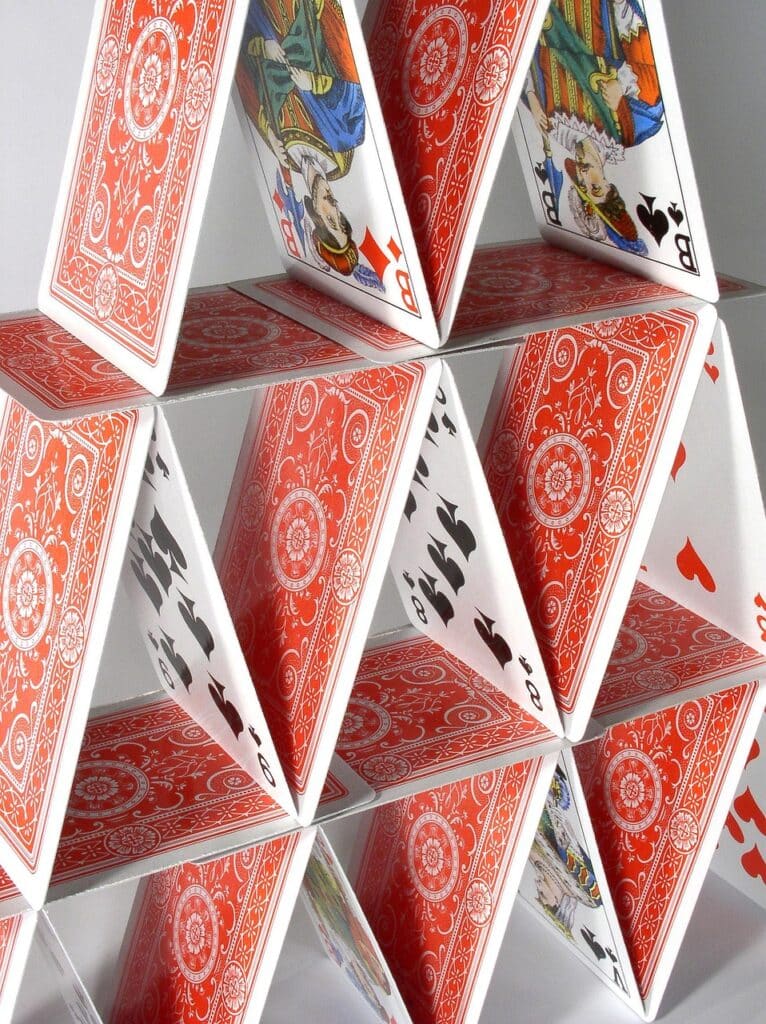
As we know from recent history, these scaffoldings or card towers tend to come crumbling down now and again, with more or less devastating economic effects. However, the system itself has proved out to benefit so many, and its removal would be so crippling to world economy (because sometimes A actually pulls it off!) that it limps on. And this is where China proves its ability to play the long game.
Money, after all, is intangible – we cannot eat it or build shelter of it. Instead, as long as one has access to it, one can use it to gather resources, build infrastructure, educate and employ workforce, make people comfortable. And this is what China has done. Starting with its ability to first provide cheap labor in an industrial scale and subsequently with its ability to manufacture anything invented anywhere at a scale if not at the quality, it has been convincing enough to play the debt game. With the promise of seemingly unending increasing productivity, China has borrowed itself into the best equipped country: while its debt is somewhere between 200-350% of its national GDP, it has in all quietness used that money to build roads, cities, train skilled workforce, buy access to resources in e.g. African continent, develop its energy grid to increasing self-sufficiency (did you think that the record solar panel fields were for nature’s benefit? Think again), and to access all technological and scientific knowhow it has desired, especially focusing on the most impactful tool yet invented, AI. In short, it has used the unreal money to get real things – not merely more money, as the capitalist societies are wont.
China knows full well that the peaceful era of the past century is over, that the biosphere is wrecked to the extent of causing dire harm to humans, and that the card house of finance economy is about to collapse. There are no powers that can even try to collect China’s debt, because where the other nations labored under the complacency of eternal peace and sanctity of trade and globalization driven economic growth, China played the game on real stakes, not money.
Fortunately for the rest of us, the Chinese mindset has never been conquistadorial or evangelical. They’re happy in their own turf, but woe betide any external powers who aim to go collecting or disturbing what they do on it. Think of China as a red neck survivalist writ large – they’ve stocked their larders with cans and guns, and intend to sit out the upcoming calamities be they directly (you know, wars) or indirectly (environmental disasters) human driven. When the dust clears in a couple of centuries, they’ll have a different dynasty in power, but otherwise plus ça change…
Back to history
Europe is reeling. We really believed that the last big bang was The Last Big Bang – after all, isn’t that why we gave the junior member of the ol’ boys club, USA, the mandate to become a military superpower? We also believed, that if we have learned to co-exist on our puny little area with such different personalities as stiff Brits, laissez-faire French, rigid Germans, lazy Mediterraneans, blue-eyed Scandis and even former Soviets, surely that was a sign that humanity can learn to live peacefully?
But with all our history, we forgot about history. And historically, the era between WWII and fall of the wall was an exception, not a result of some magical cultural evolution, Progress. We had not reached the End of History despite claims and beliefs to the contrary.
The history of humanity is first and foremost a history of power and resources. During the interlude of happy times, we momentarily believed that we could shift the competition for them from the corpse ridden mud trenches to the field of economic, abstract battles. However, for two reasons this turned out not to be a sustainable solution – at least within the type of economic system we this time essayed.
First, we screwed up with the economic system. Not only is it a far-fetched idea to aim at infinite growth within the confines of a finite planet (as the research on planetary boundaries aptly shows), but economic activities aimed merely at producing more abstract economic entities, money (financial markets), skews the focus of activities. Economy should be a tool that humanity can use to improve its lot, and not the other way around: currently the humanity is a tool that is used to pursue economic ends, the creation of more money.
The second cause is related to the first one: we simply cannot eat money, drink money or breathe money. Paper money burns, so it could be used for warmth, but otherwise it’s no good even for a shelter. Coins make a cold and lumpy bed. In other words, no matter how much abstract money someone has, it’s only the resources that one can actually use with it that matter. And as we’re drilled, pumped, killed and otherwise wrought havoc on the planet, those resources are becoming scarce. The rarer the genuine resources, the less value money has in attaining them – other means are engaged.
So, the battle for power and resources is gradually changing the field again, back to history and its mud trenches.
What if it’s like this now?
With a population of 350 million people, it’s not a happenstance that they put a clown like Trump in charge. Remember, this is the country that perfected the magic of marketing – and like we know, the key to success in any form of magic is misdirection. While we sophisticated Europeans make horrified noises in response to every utterance of the aging buffoon, we don’t pay attention to what’s really going on: Venezuela has oil, Greenland is rich in a number of resources becoming increasingly scarce.
China in turn already secured the untapped resources from Africa and is paying attention to the vast and mostly empty Russian territories to their north. Russia is the largest country in the world, even after the disintegration of USSR, and while their society has never been too stable, it is, if anything, persistent – they’ll hold on to their resources that suffice nicely for the population remaining after the wars, even if they have to yield some eastern regions to the better organized China.
So, Russia and China have secured sufficient resources for their needs and USA has the biggest army. That threatens to leave us complacent Europeans out of the next chapter of history.
The good news is that there’s not that many resources left in our region that any of the bigger powers would be too keen to come charging in. They’ll leave us to our squabbles and laugh into their beards as the climate change refugees from Northern Africa and Middle East join in. Maybe it serves us only right – after all, we are the source of colonialization, current economic system and an immeasurable amount of human suffering caused for peoples in the other corners of the world throughout history.
So what?
I don’t know if this is what’s happening. But it is one way of seeing the current geopolitical turbulence and environmental situation. Naturally I hope it’s not the right picture, or at least not the full picture – we’re somewhat complex beings who’ve created quite a complex mess.
But what if there is some truth to this interpretation? Shouldn’t we at least entertain the notion that maybe the naïve call for more economic growth isn’t the one European – and Finnish – politicians should be solely focused on? Maybe we should instead take a look at the real things, not the fictional metric of money.
Maybe I should learn to grow that carrot.