Introduction
Food systems are the biggest single contributor to the accelerating biodiversity crisis. In Finnish diet coffee has been found to be one of the products causing the most biodiversity impacts. This is both because of its high consumption amount and because coffee is grown in biodiversity rich areas where food production causes more harm to biodiversity per area land used for agriculture compared to, for example, northern countries. Thus, finding ways to reduce the impacts of coffee consumption is very important.
Traditionally, coffee has been grown in agroforestry systems where trees are integrated on the fields along with coffee bushes providing shade against excess sun exposure and often also producing more than just one crop on the same area of land. However, in recent decades monoculture coffee production, called conventional coffee production in our study, has been preferred in order to maximize fields. In conventional coffee production systems coffee is grown under full sun without any trees or other plants integrated on the field and usually with high amounts of agrochemicals used. But on the other side of the coin this trend has had mostly negative impacts on biodiversity according to previous studies.
Nonetheless, life cycle assessment (LCA) based studies on the biodiversity impacts of agroforestry coffee were lacking which is why we compared the biodiversity impacts of agroforestry and conventional coffee production using LCA in our study. Colombia, the third largest coffee exporter in the world, and more specifically the Cauca Valley montane forests ecoregion area was chosen as the location of coffee production. The purpose of the study was also to analyse how well the biodiversity impact assessment methods used in our study are able to distinguish these two coffee production systems.

How the biodiversity impacts were calculated
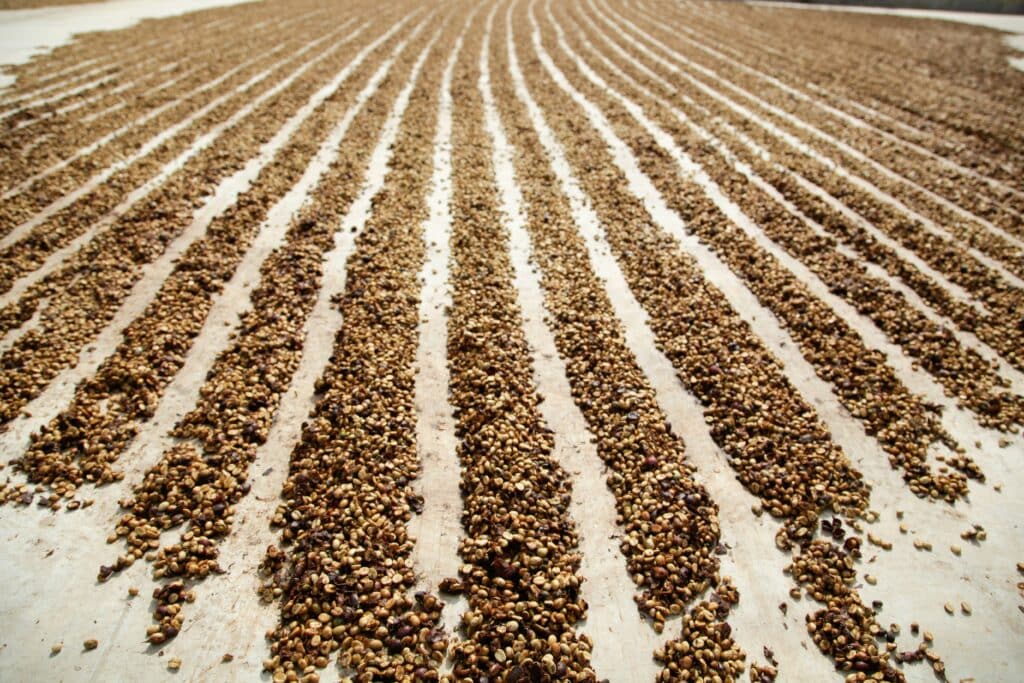
LCA is a methodology commonly used to quantify the environmental impacts of e.g. products and services throughout their life cycle all the way from raw material acquisition to the use and end-of-life. In our study, we calculated the biodiversity impacts of coffee from cradle to farm gate. In other words, the impacts were calculated for the agricultural production of coffee, post-harvest operations including the wet method where the skin of coffee cherries and mucilage (second layer) are removed using pulping machine and water, and the manufacturing of different inputs used in the production, such as fertilizers and diesel used in machinery. The impacts were calculated for 1 kg of parchment coffee (dried coffee beans with a protective parchment-like layer). The biodiversity impacts were calculated based on various pressures, namely land use, climate change, freshwater eutrophication, marine eutrophication, acidification and water use. The biodiversity impact assessment methods used were GLAM and LC-IMPACT that measure impact on global species loss using potentially disappeared fraction of species (PDF) as their unit. This unit describes the percentage of species potentially going extinct on a global level if the pressure continues. Also, the impacts were calculated on three ecosystem types: terrestrial, freshwater and marine.
Key findings from the study
As a result, the biodiversity impacts of agroforestry coffee on all three ecosystem types were lower than those of conventional coffee. More specifically, the biodiversity impacts of agroforestry coffee were 42 % lower on terrestrial ecosystems, 35 % lower on freshwater ecosystems, and 32 % lower on marine ecosystems. Thus, the results indicate agroforestry coffee production in the studied region of Colombia being clearly better option for biodiversity. However, more research is needed to draw generalized conclusions about whether this result applies in other coffee producing regions as well. But in general, it is known that, as the impacts of climate change become stronger in the future, agroforestry production systems can provide more stable and potentially higher yields compared to conventional production systems because they are more resilient to rising temperatures and unstable weather conditions. Thus, agroforestry coffee systems are a very potential option not only for reducing biodiversity impacts but also adapting coffee production to climate change.
The LCA based biodiversity impact assessment methods used in our study appeared to be sufficient to differentiate the two coffee production systems, for example through differences in yields and amount of inputs added to the field. However, some benefits of agroforestry may still be underestimated or neglected, such as improved ecosystem services through better water retention capacity and soil health. Thus, methodological improvements are still needed.
How can everyone reduce the biodiversity impacts of coffee consumption
The key message of this study is that if you love coffee and but also care about biodiversity, prefer quality over quantity. According to the mitigation hierarchy, avoiding harm should always be preferred when considering minimization of environmental impacts, so in this case reducing the overall coffee consumption. In practice you can, for example, think about whether you need to drink a whole pot of coffee during the day or if just one or two cups would be enough. Also, avoiding wasting coffee is important, so only make that amount of coffee that you will drink. When you pour coffee into a sink, all the inputs, land area, emissions and so on needed to produce that coffee go to waste, too.
Along with reducing coffee consumption, preferring agroforestry coffee over conventionally produced coffee has a lot of potential in mitigating the impacts of coffee consumption on biodiversity. When buying coffee, support brands that disclose ecological farming practices. For example, certificates, such as Rainforest Alliance and Fairtrade tell that the coffee has been produced in a more environmentally sustainable way, such as implementing agroforestry. Good advice to businesses, in turn, is to source coffee from agroforestry systems and make it visible to consumers.
References
Acosta-Alba I, Boissy J, Chia E, Andrieu N (2020) Integrating diversity of smallholder coffee cropping systems in environmental analysis. Int J Life Cycle Assess 25:252–266. https://doi.org/10.1007/s11367-019-01689-5
Bhattarai S, Alvarez S, Gary C et al (2017) Combining farm typology and yield gap analysis to identify major variables limiting yields in the highland coffee systems of Llano Bonito, Costa Rica. Agric Ecosyst Environ 243:132–142. https://doi.org/10.1016/j.agee.2017.04.016
FAOSTAT (2024) Trade. Crops and livestock products. FAOSTAT. https://www.fao.org/faostat/en/#data/TCL
ISO (2006) ISO 14040: 2006 Environmental management – life cycle assessment – principles and framework. International Organization for Standardization, Geneva, Switzerland
Jezeer RE, Verweij PA, Santos MJ, Boot RGA (2017) Shaded coffee and cocoa – double dividend for biodiversity and small-scale farmers. Ecol Econ 140:136–145. https://doi.org/10.1016/j.ecolecon.2017.04.019
Järviö, N, Sun, Z, Bruckner, M, Uusitalo, V, Scherer, L, Brandão, M, and Tuomisto, H (submitted) Biodiversity impacts of 617 food items consumed in Finland.
Rainforest Alliance (2022) Agroforestry-Resilient land use through more holistic production systems. https://www.rainforest-alliance.org/wp-content/uploads/2022/01/agroforestry-resilient-land-use-through-more-holistic-production-systems.pdf
Reilu kauppa ry (2024) Suomalaisen kahvinjuonnin vaikutukset ihmisiin ja ympäristöön- Raportti kestävän kahvintuotannon tilasta ja Reilun kaupan roolista siinä. https://reilukauppa.fi/wp-content/uploads/2024/09/Kahviraportti_2024_Reilukauppa.pdf
Savallampi J, Järviö N, & Uusitalo V (2025). Evaluating global species loss from coffee production in agroforestry and conventional systems using life cycle assessment (LCA). The International Journal of Life Cycle Assessment. https://doi.org/10.1007/s11367-025-02527-7
Scherer L, Rosa F, Sun Z et al (2023) Biodiversity impact assessment considering land use intensities and fragmentation. Environ Sci Technol 57:19612–19623. https://doi.org/10.1021/acs.est.3c04191
Sitra (n.d.) Mitigation hierarchy. https://www.sitra.fi/en/dictionary/mitigation-hierarchy/
Verones F, Hellweg S, Antón A et al (2020) LC-IMPACT: a regionalized life cycle damage assessment method. J Ind Ecol 24:1201–1219. https://doi.org/10.1111/jiec.13018
WWF (2020) Living Planet Report 2020 – Bending the curve of biodiversity loss. Almond REA, Grooten M, Petersen T (eds). WWF, Gland, Switzerland